
A film does not need a blockbuster budget to find a large audience. But it does need a clear idea of who will watch it and how it will reach them. That is the business question at the center of Marc Benjamin’s move from specialized advertising into entertainment.
In our conversation, Benjamin describes a film strategy built around budgets of $2–5 million, experienced collaborators, and stories that can bring people together. The ambition is commercial as well as creative: make entertainment that people actively choose to watch, with a business model that can support more of it.
His route there began with media planning, a narrowly focused agency, and a growing frustration with the way media can deepen division. The connection across those experiences is an interest in how a message reaches an audience—and what happens when it does.
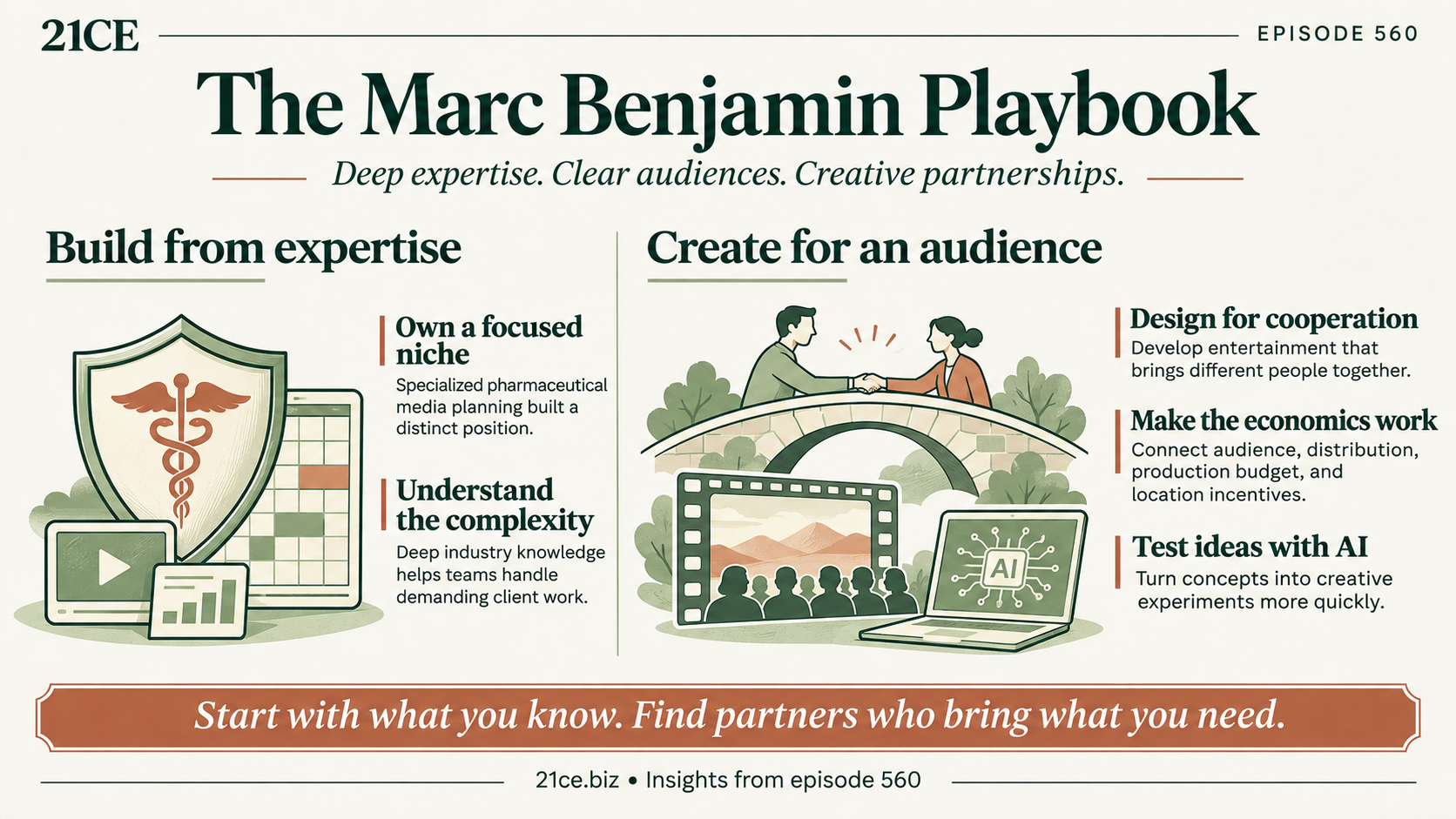
Build expertise in a lane you can understand deeply
Benjamin launched Convergence Point Media in 2007. Its focus was pharmaceutical media planning and buying, a specific service within a specific industry. He describes that specialization as one of the more consistent successes of his entrepreneurial career.
Media planning interested him because it combined psychology, creativity, and data. A different image, a change in wording, or a different channel could change how people responded. The numbers mattered because they revealed something about people and their choices.
Working in pharmaceutical communications added another layer of complexity. His team needed to understand the practical constraints of the industry as well as how to reach an audience. Over time, that accumulated experience became a reason for clients to choose the agency.
There was a tradeoff. Staying focused meant passing up some opportunities to become a broader, full-service business. Benjamin’s account shows why that can be a deliberate choice: expertise becomes more useful when a client has a difficult problem that general experience cannot easily solve.
An interesting idea still needs a business model
Benjamin is drawn to new connections: an existing capability, an unexpected encounter, and a problem that suddenly suggests a different business. He also remembers friends questioning whether some early ventures were commercially viable or simply projects he enjoyed.
Looking back, he accepts that those concerns sometimes had merit. Curiosity can start a venture, but it does not establish who will pay for it. His entertainment work developed through repeated conversations and collaborations that helped connect a personal mission with a commercial format.
In 2019, frustration with political polarization led him to create a television concept called American Lodestar. The idea paired community-minded people with opposing political views and asked them to work together on local challenges.
That concept became the starting point for Polaris Media Lab. It also gave Benjamin something concrete to discuss with people who understood television development.
Let collaborators improve the form of the idea
A key relationship was with unscripted television developer Mark Harris. Benjamin describes Harris as someone who understood the mission while seeing ways to make the concept more attractive to entertainment buyers.
The idea evolved toward a survival format. Two strangers would depend on each other for food and shelter, while the production team knew they held strongly opposing beliefs. Cooperation would emerge through the situation itself.
This was a development concept, not an account of a completed series. Its evolution illustrates an important part of Benjamin’s process: a collaborator can preserve the purpose of an idea while changing how an audience experiences it.
As their work expanded into feature films, another partner brought production experience and a track record with lower-budget films. Benjamin saw the combination of creative development, audience knowledge, and production discipline as the foundation for a studio.
Know the audience before setting the budget
Benjamin points to audiences for films on channels such as Hallmark and Lifetime as a reminder that broad appeal does not always attract the most industry attention. In his view, there are substantial audiences for stories that receive less publicity than major theatrical releases.
His proposed approach begins with the intended viewer and the likely distribution route. A film designed for a particular television audience presents different choices from one intended for festivals or a theatrical release. Those decisions shape the project before production begins.
For films in the $2–5 million range, Benjamin also sees production location and available incentives as important parts of the economics. He discusses Oklahoma as the setting for the studio’s plans. His argument is that the budget, production arrangements, audience, and route to market need to work together.
The lesson extends beyond film. Before committing resources to a product, a founder can ask: who is this for, where will they encounter it, and what makes the cost of delivering it sustainable?
Use AI to make an experiment easier to run
Benjamin sees AI as a practical way to move ideas into a testable form. He discusses researching business models, trying content formats, and completing creative tasks without assembling a large team at the earliest stage.
One example comes from music. He describes using AI to create a version of an original song with a female vocalist, then working on the mix. It gave him a way to hear an idea developed further without first organizing a conventional demo session.
That is a specific account of his experience, rather than a promise that every creative task can be automated. Its value in his story is the shorter distance between imagining something and having a result to assess.
Find the people who make the idea workable
Benjamin’s journey has not followed a straight line. Advertising, television concepts, music, and film development have each introduced people and capabilities that helped shape the next step.
The studio he describes is an ambition being built through those relationships. Its potential rests on more than enthusiasm for meaningful stories: it also depends on collaborators who understand production, distribution, and the economics of reaching an audience.
For an entrepreneur with an unconventional idea, that offers a useful next question: what do you already understand well, and whose experience would help turn the remaining uncertainty into a workable business?
Continue with the conversation.
Marc Benjamin shares the experience behind these ideas.
Listen to the conversation ↗By Martin Piskoric. Originally published on 21ce.biz.


